

Five years ago, writing a blog post took hours. You’d stare at a blank screen, hunt for sources, rewrite the same sentence five times, and still feel like it sounded robotic. Today, open a chat with ChatGPT and in under a minute, you’ve got a draft that’s clear, structured, and surprisingly human. It’s not magic. It’s a shift - and it’s changing how content gets made, forever.
What ChatGPT Actually Does
ChatGPT isn’t a search engine. It doesn’t pull facts from the web like Google. Instead, it predicts what comes next based on trillions of words it’s seen. That’s why it can write a product description, a LinkedIn post, or a 2,000-word guide without ever Googling anything. It doesn’t know if the facts are true - it just knows how to sound like someone who does.
For content creators, that means speed. A team that used to spend 8 hours on a single blog post now spends 2. The rest? Editing, fact-checking, and adding personality. That’s the real job now: not writing, but refining.
How Businesses Are Using It Right Now
Small e-commerce stores in Perth are using ChatGPT to write product descriptions for 500 SKUs in a day. One shop owner, Lisa from Fremantle, told me she used to hire freelance writers at $25 a piece. Now she generates drafts in minutes, then tweaks them herself. Her output went from 4 posts a week to 20. Her sales? Up 37% in six months.
Agencies aren’t replacing writers. They’re scaling them. A marketing firm in Sydney now uses ChatGPT to crank out 30 social media captions a day for 12 clients. Their human team focuses on tone, humor, and cultural nuance - the stuff AI still gets wrong. The result? More content, better engagement, and no burnout.
The Hidden Cost: Quality Control
But here’s the catch: ChatGPT lies. Quietly. And often.
Ask it for the top three Australian tax deductions for freelancers in 2026, and it’ll give you a detailed list - with two made-up rules. It doesn’t mean to deceive. It just stitches together patterns it’s seen. That’s fine for casual blog intros. Dangerous for legal, medical, or financial content.
Companies that skip fact-checking are getting burned. One SaaS startup in Melbourne published a guide on GDPR compliance written by ChatGPT. It misquoted Article 17. They got a warning from the OAIC. The fix? Always run AI output through a human who knows the rules.
What AI Can’t Do (Yet)
ChatGPT doesn’t feel urgency. It doesn’t care if your audience is tired of fluff. It doesn’t know your brand’s voice because you told it once - and forgot to remind it.
Try this: Ask it to write a post in the tone of a 22-year-old skateboarder from Bondi. It’ll try. But it won’t get the slang right. It won’t know that "dude" is outdated, and "mate" feels forced. Real voice comes from lived experience. AI can mimic. It can’t mean.
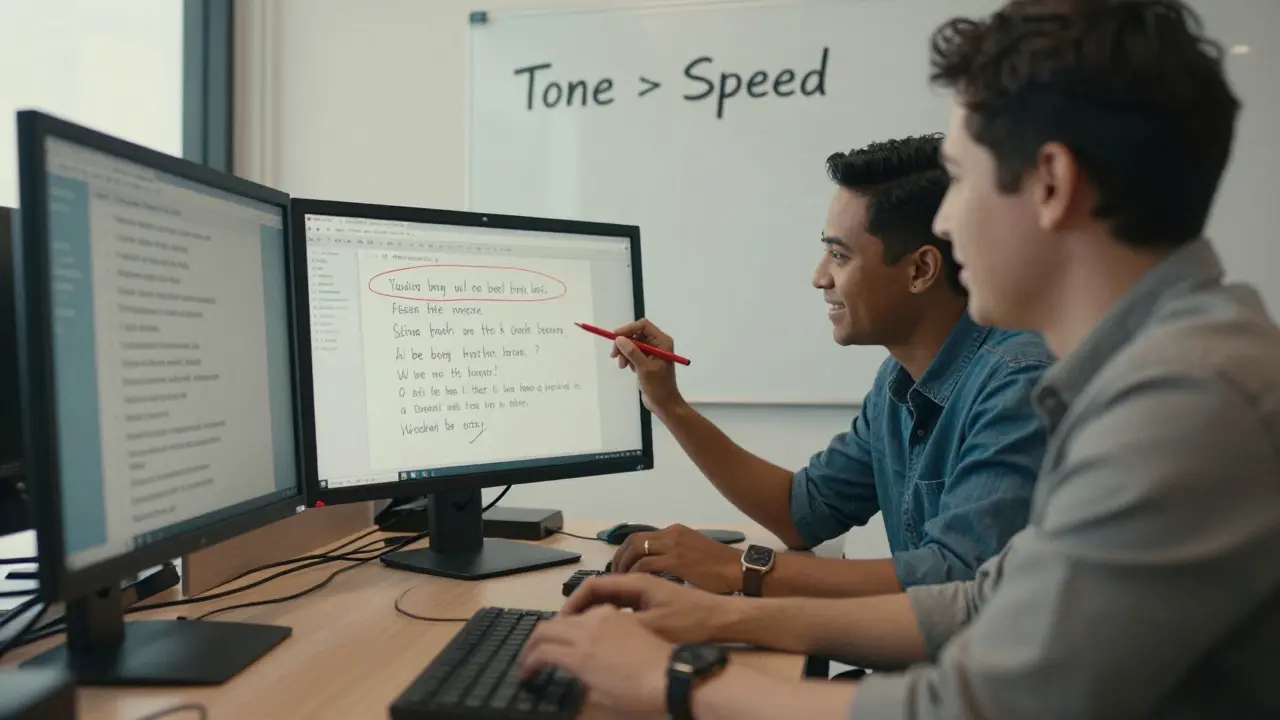
That’s why the best content teams now have two roles: the AI operator and the brand guardian. One feeds prompts. The other says: "No. That’s not us."
How to Use ChatGPT Without Losing Your Voice
Here’s how to make it work - without turning your content into a generic bot-speak factory.
- Start with a prompt that includes your brand’s tone. "Write this like a friendly expert who hates jargon, not a corporate bot."
- Give it real examples. Paste in three of your best past posts. Say: "Write the next one like these."
- Always edit. Not just for errors - for soul. Did it sound like you? If not, rewrite the first paragraph yourself. That sets the tone.
- Use it for structure, not substance. Let it outline. You fill in the stories, the data, the emotion.
- Never trust it with facts. Cross-check every stat, name, date, or rule.
One content manager in Adelaide told me she uses ChatGPT to draft 80% of her posts - then spends 90% of her time on the last 20%. That’s the new math.

What’s Next? The Rise of the Hybrid Creator
By 2027, the best content creators won’t be the ones who write the most. They’ll be the ones who edit the best.
Think of ChatGPT as your first draft assistant. Your research buddy. Your brainstorm partner. But not your voice. Your voice is yours. Your experience. Your mistakes. Your passion.
AI won’t replace writers. It’ll replace lazy ones. The ones who treat content like a checklist. The ones who don’t care if it connects.
Final Thought: It’s Not About Speed. It’s About Impact.
ChatGPT can write 100 blog posts in an hour. But only you can write one that makes someone pause, think, or act.
That’s the real game changer. Not the tool. The person using it.
Can ChatGPT replace human content writers?
No - not really. ChatGPT can generate drafts fast, but it can’t replicate human experience, emotion, or brand voice. The best results come from writers who use it to save time on structure and research, then add their own insight, stories, and tone. The tool enhances, not replaces.
Is content created by ChatGPT good for SEO?
It can be - if it’s edited well. Google rewards helpful, original content, not just keyword-stuffed text. ChatGPT often writes in a generic way. To rank, you need to add real data, unique perspectives, and clear value. Use it to start, not finish.
What are the biggest risks of using ChatGPT for content?
The biggest risks are factual errors, generic tone, and brand inconsistency. ChatGPT makes up stats, misrepresents laws, and sounds like every other AI-generated piece. Without human oversight, your content loses trust - and search engines notice.
How do I train ChatGPT to sound like my brand?
Give it examples. Paste 3-5 of your best pieces and say: "Write the next one like these." Use specific tone instructions: "casual but smart," "no buzzwords," "like a friend explaining it." The more you refine its output, the better it gets. But never rely on it alone.
Should I disclose that I used ChatGPT in my content?
You don’t have to - but being transparent builds trust. If your audience values authenticity, mentioning you used AI to draft - then edited by hand - shows you care about quality, not shortcuts. Some brands do this openly. It’s becoming a sign of responsible use, not a weakness.
ChatGPT didn’t change content creation. It exposed what was already broken: the idea that volume equals value. The winners now aren’t the ones who write the most. They’re the ones who write the best - and know exactly when to let AI help, and when to step in themselves.
Latest Posts


The Impact of ChatGPT on Social Media Marketing
28/Jun/2024