

For years, SEO was all about keywords, backlinks, and technical tweaks. You’d spend hours tweaking meta tags, chasing domain authority, and praying Google didn’t penalize you for something you didn’t even know was a rule. Then came ChatGPT - and everything changed. Not because it’s magic, but because it’s fast, smart, and works 24/7 without coffee breaks.
ChatGPT Isn’t Just a Chatbot - It’s Your SEO Co-Pilot
Think of ChatGPT as the most knowledgeable intern you’ve ever had - one who’s read every SEO guide ever written, understands Google’s latest updates, and can write 10 blog outlines in five minutes. It doesn’t replace strategy, but it multiplies your output. A content team that used to crank out two long-form articles a week can now produce eight - all while keeping quality high.
Here’s how real users are using it: A small e-commerce store in Brisbane started using ChatGPT to rewrite product descriptions. They weren’t just copying and pasting. They fed it their top-performing pages, competitor content, and customer reviews. The result? A 42% increase in organic traffic in six weeks. Not because they added more keywords - but because the tone matched what real people actually searched for.
How ChatGPT Fixes the Biggest SEO Problems Today
Most SEO struggles aren’t about technical errors. They’re about content that doesn’t connect. Google’s algorithms now reward content that feels human, answers questions clearly, and keeps readers engaged. That’s where ChatGPT shines.
- Keyword research made simple: Instead of paying for SEMrush or Ahrefs, ask ChatGPT: “What are the top 10 questions people ask about ‘best running shoes for flat feet’?” It pulls from real search patterns, not just keyword volumes.
- Content briefs in seconds: Type in “Create a content brief for a blog post about ‘how to fix slow WordPress site’ targeting Australian homeowners.” It gives you headings, word count targets, LSI keywords, and even suggested internal links.
- Repurposing old content: Got a 2022 blog post that’s still ranking but feels outdated? Paste it into ChatGPT and say: “Update this for 2025 with new data, remove fluff, and make it more conversational.” It rewrites it like a pro.
One SEO consultant in Sydney told me she used to spend 6-8 hours on a single blog post. Now, she uses ChatGPT to draft the first version in 20 minutes. She spends the rest of her time editing, adding personal stories, and checking facts. Her output tripled. Her client retention went up.
Don’t Fall Into the AI Content Trap
Here’s the scary part: Everyone’s using ChatGPT. And if you just copy-paste what it spits out, Google will notice. You’ll end up with content that’s generic, repetitive, and full of fluff. That’s not SEO - that’s SEO suicide.
Google’s latest updates - like Helpful Content Update and Spam Update - are built to detect content made for search engines, not people. ChatGPT can write like a human. But only if you make it.
Here’s what works:
- Add your own voice. If you’re a local plumber in Perth, write like one. Use phrases your customers actually say.
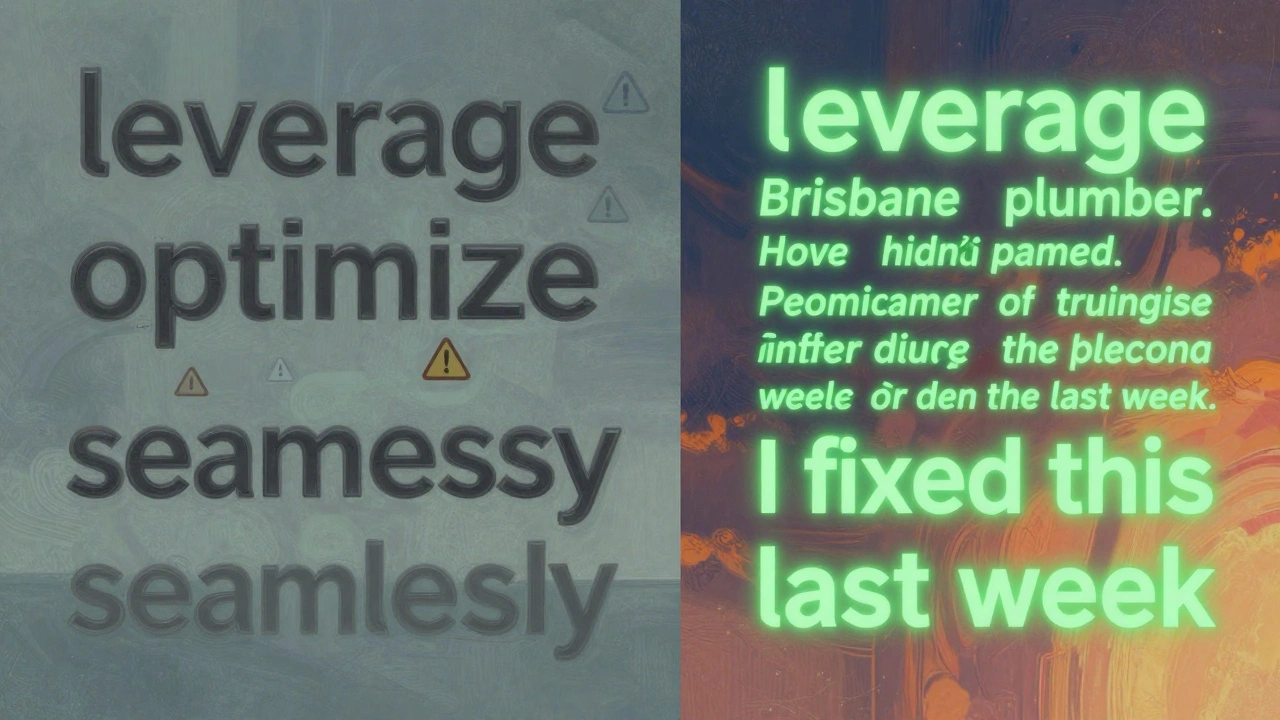
- Fix the robotic parts. ChatGPT loves words like “leverage,” “optimize,” and “seamlessly.” Cut them. Replace them with “use,” “improve,” and “smooth.”
- Insert real examples. “I fixed a slow site last week for a client in Brisbane. Here’s what I found…” That’s gold.
- Check for accuracy. ChatGPT sometimes makes up stats or fake studies. Always verify.
A study by Backlinko in early 2025 found that pages with human-edited AI content ranked 37% higher than purely AI-generated ones. The difference? Personality, specificity, and truth.
Real SEO Workflows Using ChatGPT (Step-by-Step)
Here’s exactly how to use ChatGPT for SEO - no fluff, just action.
- Find content gaps: Ask: “What are common questions about [topic] that competitors aren’t answering?” Use the answers to build new content.
- Write topic clusters: Input: “Generate a topic cluster for ‘home gym equipment’ with one pillar page and five supporting articles.” It gives you the structure.
- Optimize meta titles and descriptions: Paste your current meta and say: “Rewrite this to be more click-worthy and include the keyword ‘best budget home gym equipment Australia’ without sounding spammy.”
- Answer questions in FAQ sections: Use Google’s “People Also Ask” as your input. Ask ChatGPT: “Answer these questions in a conversational tone for a blog: [paste questions].”
- Generate schema markup: Type: “Create JSON-LD FAQ schema for a page about ‘how to clean a coffee maker.’” It gives you ready-to-paste code.
One digital agency in Melbourne started using this workflow for their clients. They reduced content production time by 60% and increased average session duration by 2.3 minutes. That’s not a coincidence - it’s because their content finally matched what people wanted to read.
What ChatGPT Can’t Do (And What You Still Need)
ChatGPT isn’t a replacement. It’s a tool. And like any tool, it has limits.
- It can’t build backlinks. You still need to reach out, guest post, and create shareable assets.
- It doesn’t know your audience. Only you know if your customers are 60-year-old retirees or 22-year-old gamers.
- It can’t track rankings. You still need Google Search Console, Ahrefs, or Ubersuggest.
- It won’t fix broken site structure. Technical SEO? That’s still on you.
Think of ChatGPT as your assistant, not your boss. It handles the heavy lifting of writing and organizing. You handle the strategy, the authenticity, and the human touch.

Getting Started: Your First 3 Actions
If you’re new to using ChatGPT for SEO, start here:
- Take one old blog post. Paste it into ChatGPT and ask it to update it for 2025. Then edit it yourself. Add one personal story.
- Use it for keyword ideas. Ask: “What are long-tail keywords for ‘best air fryer for small kitchens’ in Australia?” Use those in your next 3 posts.
- Try the FAQ trick. Go to Google, search your main keyword, copy the “People Also Ask” questions, and ask ChatGPT to answer them. Add those answers to your page.
That’s it. No fancy tools. No expensive software. Just you, ChatGPT, and a little bit of editing.
Final Thought: SEO Is Still About People
ChatGPT didn’t change SEO. It just made it easier to do it right. The best SEO content still answers questions clearly, solves problems fast, and sounds like it was written by someone who actually cares.
Use ChatGPT to save time. Use your brain to make it matter.
Can ChatGPT replace SEO professionals?
No. ChatGPT is a tool, not a strategist. It can write content faster, suggest keywords, and fix grammar - but it can’t understand your brand voice, build relationships with other websites, or interpret Google’s algorithm updates. SEO professionals still make the decisions, set the goals, and ensure the content connects with real people.
Is content written by ChatGPT penalized by Google?
Not if it’s edited properly. Google doesn’t ban AI content - it bans content made to trick search engines. If you copy-paste ChatGPT’s output without adding value, personal insight, or accuracy, it will rank poorly. But if you use it as a starting point and improve it with real experience, Google rewards it.
What’s the best way to use ChatGPT for keyword research?
Ask it to generate questions people actually ask about your topic - not just keyword lists. For example: “What are the top 10 questions homeowners in Australia ask about solar panel maintenance?” Then use those questions as long-tail keywords. This approach matches how people search, not just how tools predict search volume.
How do I make ChatGPT content sound less robotic?
Start by cutting filler words like “leverage,” “utilize,” and “in order to.” Use contractions (don’t, can’t, it’s). Add personal examples, local references, and real data. Read it out loud - if it sounds like a textbook, rewrite it. The goal is to sound like a knowledgeable friend, not a Wikipedia page.
Can ChatGPT help with technical SEO?
Only a little. It can generate schema markup, suggest meta descriptions, or explain what a canonical tag does. But it can’t fix broken links, speed up your site, or fix crawl errors. For technical SEO, you still need tools like Screaming Frog or Google Search Console - and someone who knows how to use them.
Next Steps: What to Try Today
If you’re serious about using ChatGPT for SEO, don’t wait. Start small:
- Take one piece of underperforming content and update it using ChatGPT.
- Use it to generate 5 new blog ideas based on competitor gaps.
- Ask it to write a sample FAQ section for your homepage.
Within a week, you’ll see the difference - not just in how much you produce, but in how much it actually works.
Latest Posts