

Quick Wins for Your Workflow
- Keyword Expansion: Stop guessing. Use AI to find long-tail variations that actual humans search for.
- Schema Markup: Generate complex JSON-LD code in seconds instead of manually coding it.
- Content Outlining: Build a logical flow that satisfies user intent before you write a single word.
- Meta Description Drafting: Create five different versions of a meta tag to A/B test which one gets more clicks.
Mastering the Art of AI-Driven Keyword Research
Keyword research used to be a tedious process of digging through CSV files and spreadsheets. Today, Search Engine Optimization (SEO) has shifted toward ChatGPT for SEO tasks by focusing on semantic clusters rather than single words. Instead of just targeting "best running shoes," you can ask the AI to identify the pain points of a marathon runner. This helps you find "latent semantic indexing" (LSI) keywords-terms that search engines associate with your main topic.
For example, if you're writing about a vegan diet, the AI can suggest related entities like "plant-based proteins," "B12 deficiency," and "cruelty-free living." By covering these related topics, you signal to Google that your content is comprehensive. The trick is to avoid generic prompts. Instead of saying "Give me keywords for coffee," try "Act as an expert barista and list the 10 most common questions beginners ask about pour-over coffee brewing." The specificity of the output is directly tied to the specificity of your input.
Writing Content That Actually Ranks (And Doesn't Sound Robotic)
We've all seen it: the AI-generated article that uses words like "delve," "tapestry," and "comprehensive guide" in every paragraph. Readers can smell that a mile away, and search engines are getting better at identifying low-effort AI spam. To win, you need to apply the E-E-A-T framework: Experience, Expertise, Authoritativeness, and Trustworthiness.
AI is great at the "Information" part, but it has zero "Experience." It has never actually tasted a piece of cake or used a specific software tool. Your job is to inject real-world data and personal anecdotes. If you're reviewing a vacuum cleaner, use ChatGPT to structure the technical specs, but write the part about how it handles pet hair on a shag rug yourself. That's the gap where human creators still hold the edge.
| Feature | Pure AI Output | Human-Enhanced AI |
|---|---|---|
| Fact Accuracy | Prone to "hallucinations" | Fact-checked and verified |
| Tone | Generic and repetitive | Conversational and unique |
| User Intent | Surface-level answers | Deep, problem-solving insights |
| E-E-A-T Score | Low (no personal experience) | High (expertly curated) |

Technical SEO: Let the AI Do the Heavy Lifting
Not everyone is a coding wizard, and that's where OpenAI's models shine. Technical SEO often involves repetitive, logic-based tasks that AI handles perfectly. Take Schema Markup, which is a set of semantic vocabularies that help search engines understand the content of a page. Writing a "Recipe" or "FAQ" schema by hand is a recipe for typos and errors.
You can simply paste your article text into the AI and ask it to "Generate a JSON-LD FAQ schema for the following questions." Within seconds, you have a block of code that you can drop into your header. This increases your chances of winning a "rich snippet" on the search results page, which can significantly boost your click-through rate (CTR). Similarly, you can use AI to write Regular Expressions (RegEx) for Google Search Console to filter specific URL patterns, saving you hours of manual auditing.
Avoiding the "AI Penalty" and Quality Pitfalls
There is a persistent myth that Google penalizes AI content simply because it's AI. That's not true. Google's official stance is that it rewards high-quality content, regardless of how it's produced. However, the problem is that most people use AI to produce *low-quality* content. When you pump out 50 mediocre articles a day, you're not being penalized for using AI; you're being penalized for providing a bad user experience.
To avoid this, treat the AI as your first draft, not your final version. Every piece of content should undergo a "Human Polish" phase. Check for hallucinations-where the AI confidently states a fact that is completely wrong. For instance, if you're citing a law or a medical statistic, verify it against a primary source. If the AI says a specific tool is the "best in the world," challenge it to explain why based on specific metrics like load speed or pricing.
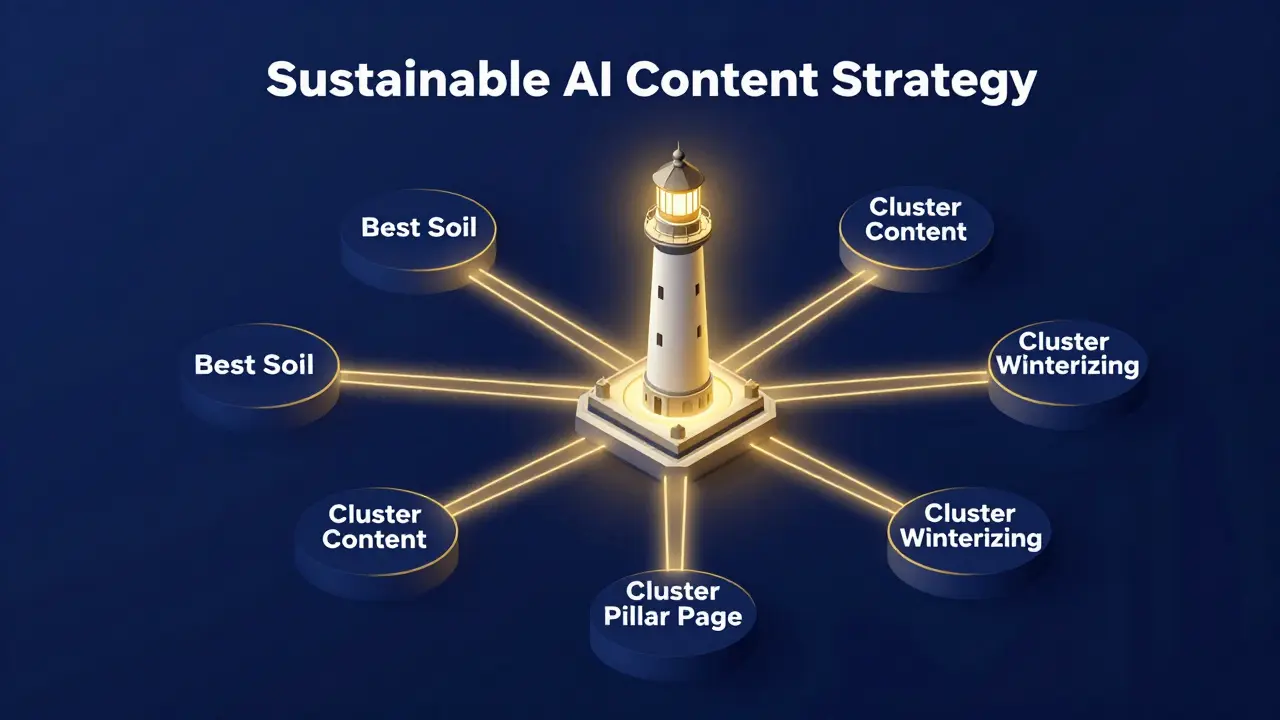
Building a Sustainable AI Content Strategy
If you want to scale your organic traffic in 2026, you need a system. Don't just prompt randomly; build a content pipeline. Start by identifying a "pillar page"-a comprehensive guide on a broad topic. Then, use AI to brainstorm "cluster content"-smaller, more specific articles that link back to the pillar. This internal linking structure tells search engines that you are an authority in that specific niche.
For example, if your pillar page is "The Ultimate Guide to Home Gardening," your clusters might be "Best Soil for Tomatoes," "How to Fight Aphids Naturally," and "Winterizing Your Greenhouse." Use the AI to ensure there is no overlap between these articles, keeping each one distinct and valuable. This avoids the issue of keyword cannibalization, where two pages on your own site compete for the same ranking.
Does Google penalize AI-generated content?
No, Google does not penalize content simply because it was created by AI. They focus on the quality and usefulness of the content. If AI content is helpful, accurate, and satisfies user intent, it can rank highly. The penalty happens when the content is unhelpful, thin, or deceptive.
How can I make AI content sound more human?
The best way is to add personal stories, original case studies, and a unique point of view. Avoid the generic introductions and conclusions the AI typically provides. Read your text aloud-if it sounds like a textbook or a corporate brochure, rewrite those sections to sound more conversational and direct.
Can ChatGPT help with internal linking?
Yes. You can provide a list of your existing URLs and the text of a new article, then ask the AI to suggest the most logical places to insert links to your other pages. This helps improve the crawlability of your site and keeps users engaged longer.
Is AI content better for long-tail or short-tail keywords?
AI is exceptionally good at targeting long-tail keywords because it can easily generate variations of specific questions that users ask. For high-competition short-tail keywords, you still need a strong brand and a lot of high-quality backlinks, but AI can help you build the supporting content that makes those rankings possible.
What are the risks of using AI for SEO?
The biggest risks are factual inaccuracies (hallucinations), lack of emotional depth, and the potential for producing repetitive content. If you rely 100% on AI without human editing, you risk losing trust with your audience and potentially seeing a drop in rankings if the content is deemed "low value" by search algorithms.
Next Steps for Your AI Transition
If you're just starting, don't try to automate everything at once. Pick one area-like meta descriptions or content outlining-and master the prompting process there first. Once you see the time savings, move into technical tasks like Schema generation. For those already using AI, the next step is auditing your old AI content. Go back to articles written a year ago and add fresh data, new images, and updated personal insights to keep them relevant and high-ranking.